Last year, I visited the Markandeshwar Mahadev temple near my office with a colleague. This Shiva temple, perched just a few feet above sea level, offers beautiful sea views. When I spoke with the Panditji, he told me it was an ancient temple, though he had no idea how long it had stood there. Its location made me believe his claim. It got me thinking—Mumbai, despite its modern image, has a history that goes back at least 600 years, if not more. So why aren’t there more well-known ancient temples in the city?
I found little information online, so I decided to explore on my own. Every day on my way to work, I’d notice an old temple near the Khada Parsi statue in Byculla. Using Google Maps, I learned more about the area and discovered that this was another Shiva temple—Shri Mankeshwar Shiva Temple. There was another temple with a similar name nearby, as well as the Ghodapdev Temple. I decided to walk to all these places, and it truly felt like discovering forgotten, almost ancient temples.
Shri Mankeshwar is just a five-minute walk from Byculla station. Once inside, the peacefulness makes you forget you’re at a busy intersection, with railway tracks right behind the temple. The structure is ancient—based on what little I know of Indian architecture, it seems at least 400 years old, though the deity may have been worshipped here for a thousand years.
About 20 minutes away is the other Mankeshwar Temple, near Dockyard Road station, opposite the harbour line tracks. To reach it, you climb a few steps from the main road, and it’s tucked away among residential houses. The temple is managed by a local family. The Shiva idol here is unlike any I’ve seen—a fierce, bearded Shiva holding Parvati in one arm and Ganesha in the other.
To get to the Ghodapdev Temple, which sits parallel to the harbour line between Reay Road and Cotton Green stations, I had to navigate heavy truck traffic and dug-up roads. I wouldn’t recommend walking here after dusk, as there’s little street lighting and the area is lined with mechanical workshops and trucks from the MPT area, making it less safe.
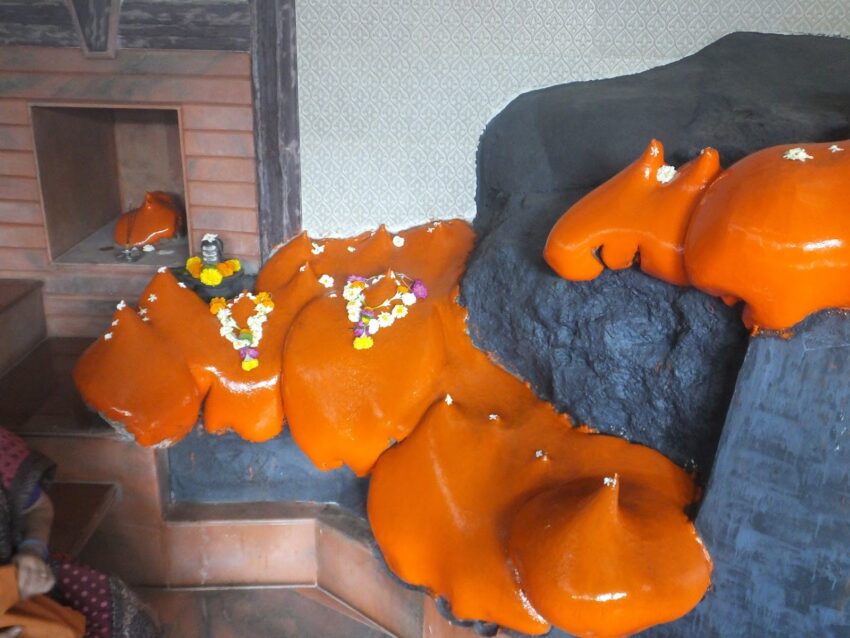
Despite the challenges, I’m glad I visited the Ghodapdev Temple—it’s truly unique. Hidden among residential homes, it’s mostly known only to locals. I got quite a few curious looks when I entered. The deity here isn’t a typical idol but resembles a molten lava formation, which makes sense given that the area around Sewree, Parel, Reay Road, and Dockyard Road was formed by volcanic eruptions millions of years ago. That’s also why there are so many ascents and declines in the area, and many places are only accessible by steps.
If you’re interested in Mumbai’s ancient temples, these are a must-visit. The energy in these temples is incredible—something you can only feel in truly ancient Shiva temples. Other well-known old temples include the Bhuleshwar Shiva Temple and the Walkeshwar Temple at Malabar Hill. The Shiva deity at Walkeshwar is believed to have been consecrated by Lord Ram himself. There’s also the Prabhadevi Temple, which is often mistaken for the Siddhivinayak Temple at Dadar. In reality, Prabhadevi Temple is on the road next to Siddhivinayak and is dedicated to the goddess Prabhadevi, built in classic Maharashtrian style.
Do visit and support these temples—they are in dire need of funds for maintenance. Your contribution will help preserve our culture, history, and traditions.