3rd March 2017
After much deliberation, I finally set off for Bhuj on the Bhuj Express in the afternoon. I was a bit apprehensive since it was March and Gujarat can be quite hot at this time of year. My research was rough, and apart from the Rann of Kutch, I wasn’t entirely sure where I wanted to go. I really wanted to visit Dholavira, but I dropped the idea as it was too far for a three-day trip. It had been 11 years since I last visited Gujarat, and I was excited to travel the same route I used to take so often—so many fond memories. The train left at 2:45 pm, and with a 15-hour journey ahead, I was genuinely looking forward to it.
I got off at Baroda for a quick two-minute stop. The place seemed to have changed—well-lit with some new bridges. Unfortunately, there wasn’t enough time to look around. Ahmedabad and Anand stations arrived in the middle of the night, otherwise, I would’ve gotten off there too.
4th March 2017
I reached Bhuj at 7 in the morning. Bhuj railway station is quaint, with just two platforms, a few trees, and lots of greenery. I would have liked to linger and soak it in. My hotel—Click Hotel Bhuj—was conveniently located within the railway compound. There were plenty of autos available for Mandvi right there, making it easy if you want to head out immediately. After checking in, I asked the helpful front office staff about a vehicle for sightseeing, and they quickly arranged one for me. Since I had some time, they suggested I visit Bhuj’s tourist sights as well as the Rann of Kutch—the Dhordo village—which was quite doable.
After freshening up, I left the hotel around 9 am. My first stop was the Swaminarayan Temple. Like most Swaminarayan temples, this one is an architectural delight—peaceful, made of marble and red stone, amazingly clean, and well-organized. Next, I visited Bhuj Palace. It’s a beautiful structure with clean lines and a tall tower offering a panoramic view of the city. Although part of the palace was destroyed during the earthquake, most of it still stands. There was a school trip there, and it was lovely to watch the kids chatting away. The king no longer resides in the palace, but the artifacts remain as a museum. The tower is small with a steep staircase, good for only one person at a time.
Right next to Bhuj Palace is the Aina Mahal, a single-storey building where the king used to enjoy music. The music room is surrounded by glass lamps and chandeliers, giving the palace its name. There are also some beautiful paintings, but the highlight is the intricately detailed ivory door—absolutely stunning. Both the Aina Mahal and Bhuj Palace are next to Hamirsar Lake, which must be beautiful during the rains but was sadly in a state of disarray during my visit, with locals washing clothes on the banks and little water in the lake.
Our next stop was the Chattardi, which I found to be the most beautiful place in Bhuj. It’s a 10-minute drive from Bhuj Palace, almost on the outskirts, and consists of 12 tombs of Bhuj Muslim queens, designed in the style of Hindu samadhis. The central tomb, with its 20 pillars, is especially striking. Sadly, most were destroyed during the earthquake, but the ASI is restoring a few. The place was serene and almost deserted, making it perfect for an evening visit if you have time.
Next, we went to Bhujodi, a handicraft village 8 km from Bhuj, where locals make textiles and various crafts. I did some shopping—the rates were reasonable and each store offered unique designs, so it’s worth browsing before buying. The village is essentially a small lane with about 20 shops, making it easy to explore. I spent a couple of hours there.
On the way, we stopped at a chowk in Madhapur, where the Air Force has paid tribute to the women of Bhuj who helped construct an airstrip during the 1971 war in just 72 hours—a beautiful and moving tribute. I had never heard this story before.
From Bhujodi, we drove to Kala Dungar, a couple of hours away. The route passes through the Rann of Kutch—a flat, barren desert, not yet the iconic white salt desert. Kala Dungar is a cluster of hills next to the white Rann and is the highest point in Bhuj. On a clear day, you can see the Pakistan border. The view of the Rann stretching out in front of you, with a few creeks of water, is breathtaking. There’s a small Devi temple on the hill, and if you arrive before 2 pm, you can get prasad from the pujari, who first offers it to the foxes. If the foxes don’t turn up, the pujari doesn’t eat. Unfortunately, I missed both the prasad and the foxes as I reached around 3:30 pm. I spent half an hour taking in the mighty Rann. There are camels here that, for Rs. 50, will take you to the highest point, but it’s a short, easy walk.
We then drove to India Gate, about half an hour from Kala Dungar. You need permission from the BSF at the check post, which is easy to get if you arrive early. Beyond India Gate, the only thing to see is the war memorial, 10 km further. It’s an unimpressive spot, with no village or people around and little architectural interest. There’s a BSF post nearby where troops sometimes rest. The local Muslims dress like Pakistanis, which was interesting to see, while the Kutchi men and women wear their traditional, colorful attire.
Next, we went to see the Rann of Kutch. We stopped at Bhandariya village for permission (Rs. 100 per person plus car charges). The village is about an hour from India Gate. We reached the Rann just in time for sunset. Cars stop a few kilometers from the Rann, and camel carts (Rs. 100 per person) take you the rest of the way—a fun ride, especially with the Bohri families I joined. There’s a tower at the edge, beyond which camel carts don’t go. The sight of the white salt stretching to the horizon, with the sun setting over the flat earth, was surreal. The salt was hard, not sandy as I expected, and the sunset felt like the sun was dropping off the edge of the world. It was a unique experience—peaceful and almost otherworldly. After sunset, I climbed the tower for a panoramic view. The place was nearly empty, and a group of Bohri women offered namaz there, leaving me to enjoy the silence. There are a couple of camels for rides and some musicians playing garba near the tower. On the way back, I stopped at Bhandariya village to buy local mava—delicious and cheap at Rs. 200 per kg. I reached the hotel around 9 pm and, exhausted, had dinner there.
5th March 2017
The next day, I planned to explore western Bhuj. I started around 8 am with a different car and driver—Ajay, a talkative local who shared a lot about the area and its history. He told me that 80% of Bhuj and its residents were destroyed in the earthquake, and the city has been entirely rebuilt over the last 15 years. The older generation is gone, and the people of Bhuj are laid-back, with most owning shops and closing businesses in the afternoon—a contented lot, much like Goans.
Our first stop was Hari Mata Temple, a beautiful and clean Swaminarayan temple on the city’s outskirts. Next was Purneshwar Shiva Temple, right on the road—a 3,000-year-old temple with a partially caved-in roof from the earthquake. It’s the most beautiful temple I’ve seen, with an eerie atmosphere. The temple is made of perfectly cut stones without cement or binders, so the foundations and walls survived the earthquake, though the roof did not. Sadly, modern tiles and graffiti mar the back wall.
Next, we visited Jadeja Taka, a temple with over 100 horse statues representing Jadeja ancestors. The temple is on a hill with lovely views of the villages—a great spot for an evening visit. It’s believed that wishes made here are granted.
We then went to Dhinodhar Temple near Than, a bit off the main road. We passed a small, peaceful pond with a few birds and no people. The temple itself is atop a hill, reached by climbing 750 steps (not too steep, about 15 minutes). There are a couple of round-shaped temples at the summit, with just a handful of visitors. We spent some time chatting with local women there.
Afterwards, we visited Mata no Madh Temple, a famous and popular temple in Bhuj. We arrived around 1 pm, so the temple was closed, but we enjoyed the free prasad—a wholesome lunch of rice, sabji, dal, and a sweet. We planned to return in the evening. The Kalpavruksh tree here is said to be the only one in India; it’s huge, and wishes are believed to be granted if you circle it. We also passed the Tropic of Cancer.
Next, we drove to Narayan Sarovar, an hour from Mata no Madh. Mentioned in the Ramayana, it has cultural significance. There wasn’t much water, but the place would be beautiful if full. The temple complex is about 300 years old, built by a local queen, and includes Shiva and Krishna temples. It’s a peaceful spot, though it could be cleaner. There’s a dharamshala for visitors.
We then visited Koteshwar Temple, 5 km from Narayan Sarovar. The sea comes into view quite suddenly near the temple, which is beautifully built right at the mouth of the sea. The rays of the setting sun fall directly on the Shiv Linga, and the architecture is lovely. The temple is said to date back to the time of Ravana. There’s a path into the sea used by fishermen, and since it leads to Pakistan, there’s a checkpoint. There’s also a small lighthouse nearby. The sea is quite deep here, with no real shoreline. I spent half an hour just soaking in the atmosphere.
Our final stop was Lakhpat, a 45-minute drive away. Lakhpat is a walled fort by the sea, much larger than I expected—about 1.4 km in diameter. The walls are mostly intact, and the village is inside the fort, with sea water touching the walls on one side. We visited the Gurudwara, built during Guru Nanak’s time, where he stayed before traveling to Mecca. The Gurudwara is beautifully maintained and peaceful, with only one Sikh family present. The names of the Muslim and Hindu workers who built it are recorded there. The village of Lakhpat is on one side of the fort, reminiscent of its old glory as a famous port city. The locals were once all lakhpatis (hence the name), but the town faded after business moved elsewhere.
The village of Lakhpat is on one side of the fort, and the entire area is reminiscent of its old glory, which has now faded with time. Lakhpat used to be a very famous port city—one of the first port cities in the region—and the locals here were all lakhpatis, hence the name. But the town quickly lost its fame after business shifted to other ports due to geographical changes. You can feel this in the aura of the place. It seems like it was once prosperous but has now lost all its glory. It’s more or less abandoned, full of ruins except for one small part where the locals still stay.
We went to the part of the fort that looks out into the sea. The gates are huge, and since there was low tide, you could easily walk a few kilometres into the sea towards Pakistan. There is a BSF outpost here, and we chatted with the BSF men. They told us a bit about the history of the place and even offered us dinner.
We left Lakhpat around 7 and reached Mata no Madh at 8. The energy of the temple is amazing—you can actually feel a divine presence there. It is beautifully maintained, and the deity is beautifully decorated. Not many people were present, so I got a good darshan. I chatted again with the local women at the temple. The silver jewellery and the clothes that the local Kutchi women wear are absolutely lovely. Ajay told me that although the women dress simply, they are very rich, as most of them are cattle herders and each cow costs upwards of Rs. 50,000. I had a beautiful time at the temple.
On the way back to the hotel, we stopped at the highest point in Bhuj, which is a small hill, and admired the lovely city spread out below. I had dinner at a local eatery—simple Gujarati food, very tasty and cheap, just what I wanted. I reached the hotel after 10:30. It had been a truly fascinating day.
6th March 2017
This was the day I had decided to visit Dholavira. Since it takes four hours to get there one way, I had initially dropped the plan. But my friend Hardik convinced me, and since I had the day free and my train was after 10 pm, I decided to go—and it turned out to be the best decision of this trip. Dholavira was so much more than I expected.
We started for Dholavira at 8 in the morning, stopping for tea at a couple of places along the way. It was a very uneventful ride. The roads of Gujarat are absolutely beautiful, even in the most remote places.
The scenery on the way was mostly flat land with a few shrubs, and villages were scarce. There were lots of cattle herds and, once, even a herd of camels—the baby camels were a delight to watch. The locals, especially the older generation, wear traditional Kutchi attire and really own the look. The women here look quite different from the local Gujjus; their features are slightly different, and they usually wear black skirts with colourful dupattas. Ajay told me a fascinating story about the colours: since Krishna died, the women here have decided to wear black, and so the tradition continues even after centuries. Amazing.
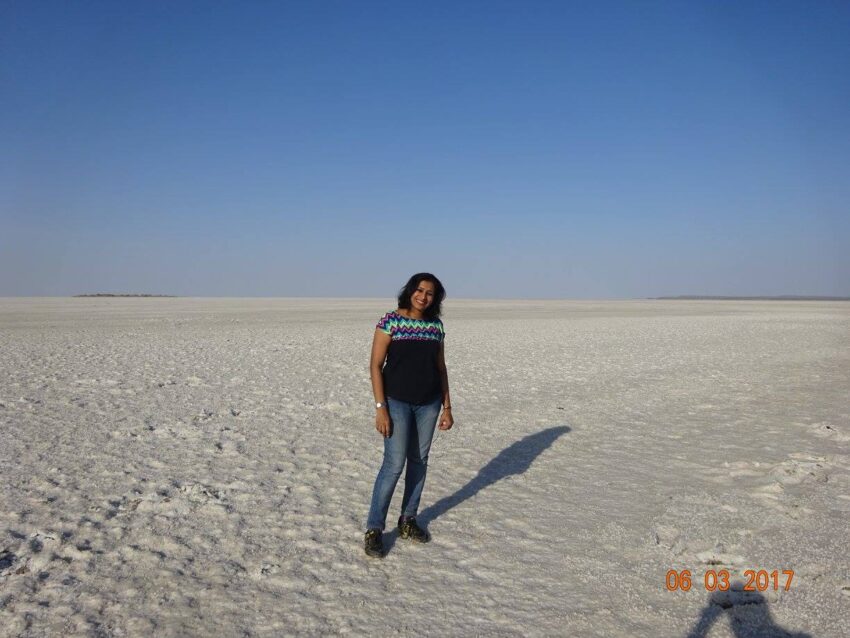
Dholavira is an island about 10 km in diameter. When you look at the map online, it seems to be surrounded by a big lake, but that “lake” is actually the Rann of Kutch, which is about a foot deep during the rains. After December, the water evaporates and what’s left is just hard salt. The road to the actual island leads through this strip of the Rann, and the sight is fabulous—totally unexpected. The road is a lovely two-lane stretch cutting through the Rann. Here, the Rann is pristine white salt with a blue horizon—just flat white land as far as you can see. I was the only one there; Ajay waited in the car, and the feeling was almost spooky. I could actually hear the silence. In the ten-odd minutes we stayed there, not a single car passed by—it was eerie. I walked a bit into the Rann and imagined the sight on a full moon night, with the white salt glistening under the moon. No wonder people flock here during the full moon. I made a mental note to come back again during that time.
We continued our drive to Dholavira. The island has a few hillocks and lots of green shrubs. Here, you can’t even tell you’re in the middle of a desert. There are a few scattered villages on the island. Dholavira is bigger than I expected—it took us about half an hour to reach the tourist centre. We had a lovely Gujarati lunch there. Except for me, there were no other tourists. We then proceeded to the ASI Museum, a small building next to the ASI Dholavira excavations. The museum contains findings from the excavations and a few pieces of pottery, along with photos of the excavation sites and general information about the ancient ruins. I then booked a local guide and went to the actual excavation site.
The site is a few kilometres in diameter, and ASI has not even dug out 10% of it. This place is a wonderland. The actual town, the rooms where people lived, the pottery, the entrance, the playground, the huge walls—all are fabulous. But the most amazing aspect was the water conservation and rainwater harvesting. Not a drop of water was wasted—even the water drawn from the well was sent for storage. The water reservoirs were huge, and there were moats everywhere. There are lots of pictorial depictions of elephants, and there’s also a board with script discovered here that is yet to be deciphered. The town planning is marvellous. Archaeologists would have a fascinating time here. There are six civilizations, one beneath the other, and ASI has not even uncovered one. There is a phenomenal amount of information not just at the site but on the entire island. I would have loved to spend more time here, but since I was short on time, we proceeded towards the fossil park.
On the way to the fossil park, we stopped at a Brahma temple on the other side of the island. The temple is on the edge of the Rann, and you can see Kala Dungar from there. Pakistan is just 40 km away and very much walkable. There’s a BSF post next to the temple. We spent some time there.
The fossil park is about half an hour away from the temple, on the other side of the island. Fossils dating back 187 crore years were discovered here. They are well-preserved, and it’s amazing how old trees have turned into stone. The Rann here looks fabulous—you can actually visualize the sea hitting the shore eras ago, not just a barren desert. A beautiful desert, though. There are a few hillocks here, and it would be amazing to stay in the evening. The view from the hillock, looking back at the Rann stretching out, is absolutely lovely.
We returned to Bhuj the same way, again through the Rann. Dholavira is a place like no other, with its fascinating history and geography. I wished I had more time to spend here. It was a hurried but worthwhile trip. It’s a place worth visiting early in the morning and spending a night. Next time, that’s exactly what I’ll do.
I left for Bhuj with some very melancholic memories of a different era and different people, and how they must have lived their lives. I did a bit of hurried shopping in Bhuj after another lovely dinner at the same place as last night, and caught my train just in time.
Bhuj turned out to be so much more than I expected. I had just gone there to see the white desert, but it was unlike anything I had imagined. The history, geography, culture, food, and clothes—not to forget the lovely, helpful people of Bhuj—were nothing like I have ever experienced.
I left Bhuj with a promise to myself to come back again soon, and next time, to visit during a full moon night.