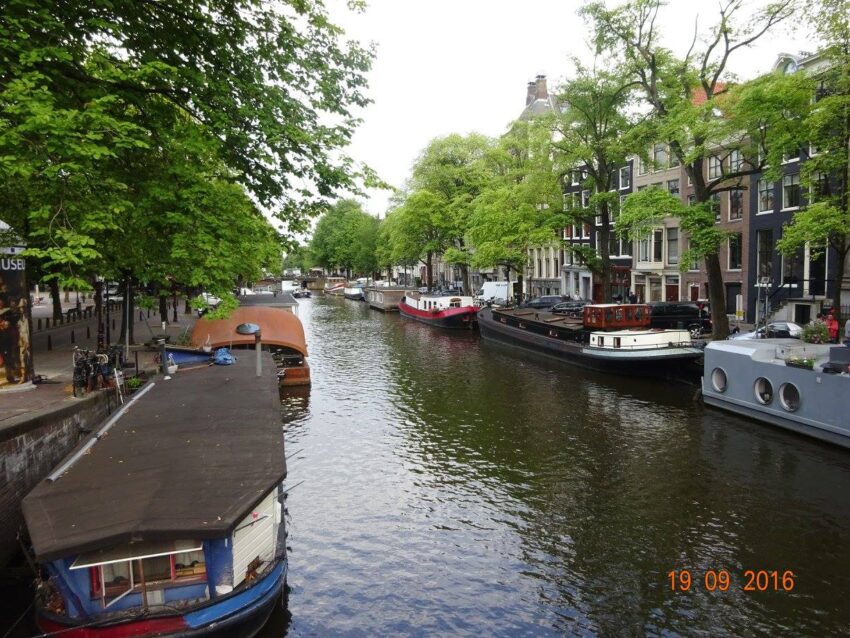
Amsterdam, from what I had read and heard—mainly due to its legal stance on drugs—was a city frequented by a younger, party-going crowd. But Amsterdam turned out to be a very pleasant surprise. With its canals, bridges, old architecture, and compact, walkable (and cyclable) layout, it is an absolutely romantic city. There are canals everywhere, and the tree-lined streets with medieval buildings and cobblestones made me genuinely happy. My first thought upon entering Amsterdam on a pleasant Sunday morning was that this is definitely not a city for a single person; you have to come here with your significant other.
The city is more famous (or infamous) for its Red Light District. I joined a Red Light District walking tour, where our guide gave us insights and insider info on the trade. Most of the women in this profession do it for the money, often to support their education. There are strict rules governing the entire operation, and the women look out for each other. This walk is a must-do in Amsterdam. The tricks employed by the women to make money are sometimes quite funny, and men often end up making fools of themselves. The Red Light District is restricted to only a few lanes and surrounds the old church, which is quite ironic. There’s an interesting story behind that, too.
I spent two days exploring Amsterdam. I stayed in a small town called Zaandam, which is a 15-minute train ride from Amsterdam. Zaandam is equally quaint, though it has fewer canals. My Airbnb host, Dewi, was Indonesian and absolutely delightful—non-intrusive, spoke very little English, and was very motherly.
There are three main canals in the city, and the entire city is built around them, crisscrossed by smaller canals. You can walk from one end of the city to the other in about 45 minutes. That’s basically what I did for two days—just walked by the museums and took pictures. I’m not too fond of museums, otherwise the Rembrandt and Van Gogh museums are supposed to be good. I also skipped the Anne Frank Museum because I thought I’d find it depressing. I did the free walking tour on the first day, which was great for learning about the city’s history.
On the third day, I did a whirlwind tour of Delft, Den Haag, and Haarlem—cities around Amsterdam. Delft was especially pretty, like a typical European town with an old town square and a couple of other squares. It’s quaint, with a few canals and a zoo. It’s a nice place to walk around and spend a couple of hours.
Den Haag is where all the government offices are. It’s also close to the sea and has a long strip of beach. Since I hadn’t been to any beaches in Europe, I decided to visit. I took a tram from Den Haag train station; it’s a 20-minute ride to the beach. The beach was crowded with people sunbathing on a very hot day. There’s a watchtower a little way out into the sea, and I decided to go up for the view. I had the entire place to myself, and it gave a bird’s-eye view of the beach and the greenery beyond. It was picturesque, and I even saw a few ships sailing in the distance. The tower is quite high, and I spent some time there. Since it was so hot, I skipped seeing the city and government offices on my way back. Den Haag is a mix of modern and old and seems to be a busy town, with many people commuting from nearby places for work.
I stopped at Haarlem on the way back to Amsterdam. Haarlem is another European city with a big square and medieval buildings, but it also has a larger canal on its periphery—more like a river, with bigger boats. There are a few high-end shops, and you can spend a few hours walking and exploring the town.
On the fourth day, I visited two places: De Veluwe National Park and Giethoorn. Both are across the country and take around two hours each way to reach, but since they were more or less on the same route, I decided to combine them in one day.
The national park is beautiful—a domesticated version of the national parks in India, with lovely trees and even a patch of sandy area in the center. There’s also a museum, which I skipped. The entrance fee includes free bicycles, which I was very excited to ride. There are no wild animals in the park, and there are a couple of routes you can cycle through. It was absolutely lovely. I wanted to ride a bicycle in the Netherlands but didn’t do so in Amsterdam, as the roads are smaller and the locals ride at breakneck speed. I wasn’t confident enough to ride in the city, so I made the most of my bicycle ride in the park. Most of the time, there was no one else in sight, and I had a wonderful three hours in the park. End to end, the park measures just 10 km, and you can explore it well. Some patches are so dense with trees that sunlight doesn’t reach the ground—the views were like the tree-lined forests you see on computer wallpapers.
Giethoorn is advertised as a village without roads. It takes around 2.5 hours one way from Amsterdam, with two or three train changes. It’s a very quaint village on a tiny canal, and there are no roads—transportation is done via small boats on the canal, which is about five feet wide. The village has delightful little cottages on both sides of the canal—about 50 cottages with lovely gardens and lawns. Roads aren’t needed because the village is so tiny. I had a lovely time walking through the village, gawking at the homes. There should be a limit to the number of pictures you can take here—the houses and the setting are so picturesque. I missed the boat ride on the canal because none were happening that day. There’s not much to do except walk around, which is delightful in itself. Since it was a sunny weekday, the locals were outside reading on benches, and there weren’t many tourists. I spent about two hours here. The village is beautiful, but you should visit only if you have plenty of time and have already seen the main sights in Amsterdam.
On the fifth day, I took a regional pass and went to the northeast of the Netherlands, just outside Amsterdam. The regional pass was a free one-day pass on all buses in a region. I spent my morning loitering in Zaandam and began the actual trip around noon. Ideally, I should’ve started earlier because this day turned out to be the best of my Netherlands stay.
I got the pass from Amsterdam Central, and the route covered four different directions. The girl who sold me the pass told me to visit the northeast part because it was the prettiest, and I was really thankful for her advice.
This region was a revelation. It’s not on any must-visit lists for the Netherlands—at least, I hadn’t read about it in my research. In my opinion, it’s so much better than any of the places I’ve visited in all my trips to Europe. The places I covered were Volendam, Monnickendam, Edam, and Marken—all harbor towns. I remember seeing loads of sails in the sea as I landed in Amsterdam, and the water body looked close to the city. I wondered what the place was and really wanted to see it. I didn’t know I’d visit this place unknowingly when I got off the bus at Volendam.
When I got off the bus, I didn’t know where to go or what to see. I spotted an ancient windmill and decided to walk in that direction. The windmill was in the middle of nowhere, surrounded by meadows, and I could see the horizon. There was a small hill nearby—calling it a hill is an overstatement; it was more like a meadow on a slight rise. You could see just this windmill with greenery and meadows as far as the eye could see. The location was so serene, with just a couple of cyclists passing by. How I wished I had a cycle that day! The location was made for cycling. I could sense a water body nearby but couldn’t figure out how to reach it, so I generally followed the direction of the wind. To my surprise, I came to a harbor where rows and rows of sailing boats were parked—so many that I could hardly see the sea. There were probably more sailing boats than people in the town! This was exactly what I’d seen from the flight, and I was so glad I stumbled upon this lovely location. This made me hurry to see the other towns in the region, as I had a feeling they’d be just as pretty.
Next stop was Edam, a quaint little town in the midst of meadows—very scenic, with the sea breeze everywhere. The houses were beautiful, and the atmosphere was peaceful and domesticated. There was a castle somewhere—at least, the map said so—but I couldn’t find it. So I did what I love: walked in a random direction through the town. There was a beautiful tree-lined street, picture-perfect, with not a soul in sight. A small church stood in the middle of town, but it was closed, so I couldn’t explore. Lovely town. I wished I could have seen the castle, but sadly, I couldn’t locate it.
Next was Monnickendam, which was more of a place to change buses for Marken. The whole area is surrounded by green meadows. On the way to the bus stop, I saw a lovely sight: we were stopped at a canal just before a bridge, and the entire bridge lifted up to let a boat pass, then was brought back down. Nice experience.
Monnickendam is another small town with serene surroundings. But the icing on the cake was Marken. On the map, it looked like an island. The bus stop wasn’t specified, so I wondered how the bus would reach there. I was pleasantly surprised when, after 15 minutes, the road suddenly turned into a strip of land just wide enough for the road, with sea on both sides and sailing boats everywhere. It was such a beautiful sight. I wanted to get off there, but the bus didn’t stop. I thought maybe the scene was similar at the last stop. When I got off at the last stop, there were just a couple of houses and wilderness everywhere. I took the bus back one stop, where there seemed to be more tourists. It was Marken village—a quaint village with about 50 houses, more like row houses, and there was an ascent in the village, too. But I was looking specifically for the bay I’d seen on the way. I toured the entire village but didn’t find it. Disappointed, I decided to head back to the bus stop to catch a bus, as I also wanted to visit Zaanse Schans. The buses ran every half hour, so I didn’t want to miss one. On the way to the bus stop, I got lost and wandered in circles. And suddenly, it happened—I saw the bay with a strip of land going into the sea, water on both sides, and many sailing boats anchored nearby. I was the only person there, and it was an awesome experience. I spent some lovely moments there. Sometimes, it’s good to get lost.
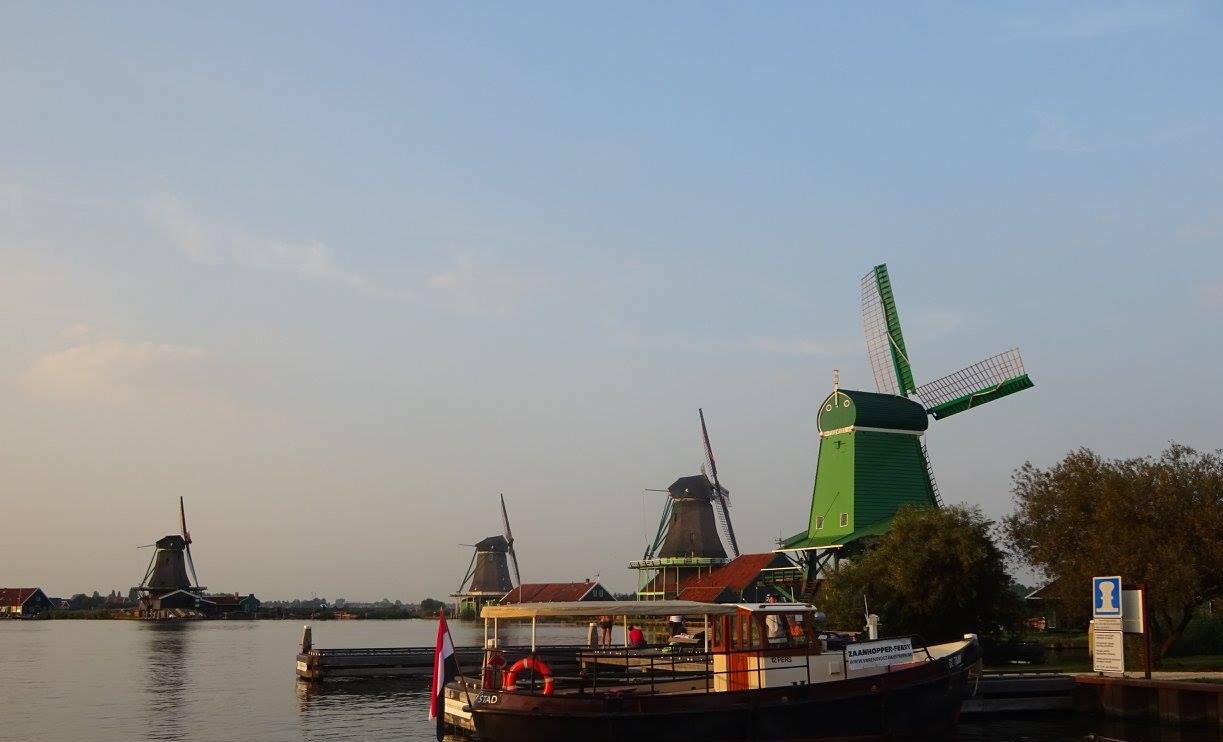
Next stop was Zaanse Schans, called the industrial heritage area. The pictures I’d seen online showed many windmills on a river, and it was exactly that—about a dozen old green windmills around a river. The windmills didn’t seem operational, but it was a beautiful sight. There were just a handful of tourists, and since the windmills were spaced out, it was a very pleasant walk. Even the houses across the river matched the windmills’ color palette. It was a quaint village, and with the sun setting on the horizon, its reflection on the water was beautiful. I crossed the bridge across the river, as my bus driver had told me, and caught the bus back to Zaandam.
This was the last day of my trip. I headed to Utrecht in the morning—a university town about 45 minutes from Amsterdam. There’s a small town square in the center, surrounded by a canal. It’s a mini version of Amsterdam, but more peaceful and less crowded. The canal here is different; the city seems to be built one level above the canal, and you reach it by steps near the bridges. A path surrounds the canal, and I was told that at night, the canals become a party zone with restaurants and bars. In the morning, everything was closed. I spent a couple of hours walking through the town by the canals, then returned to Zaandam for some shopping at Primark, and finally headed to Amsterdam to spend time at two of my favorite spots—the port area behind Amsterdam Central and the canals. I took a tram to Prinsengracht and walked to De Duif, my favorite canal in Amsterdam because I discovered it myself and found it the most peaceful. I spent about an hour there and said goodbye to Amsterdam.